Showing posts with label Luke 2:41-52. Show all posts

Friday, January 05, 2007

Point 3: Jesus takes us from the Passover to the Passion.

Comments and corrections welcome.
Read the text HERE
Read the introduction: New Year's Revolution.
Jesus takes us to three places:
Point 1: Jesus takes us from the Pious to the Personal.
Point 2: Jesus takes us from mere Information to true Insight.

Point 3. Jesus takes us from Passover to the Passion.

Here is something interesting: The Gospel of Luke is Jesus’ travel log to Jerusalem. Jesus only gets to Jerusalem in his adult ministry in Ch 19 (The so-called Triumphant entry).

In Luke’s account, there are only three recorded times that Jesus goes to Jerusalem before he begins his adult ministry.

As a baby, his parents offer a sacrifice, as was the pious duty of a Jewish parent.
As a boy, our text here, at Passover time.
As a man, just before he begins his ministry, the devil takes him to Jerusalem to tempt him NOT to take the path of the cross. The devil basically tempts Jesus saying that God wants Jesus to have his Best Life Now, and to avoid the cross, and conflict, and suffering, and rejection.

Each time, there is this foreshowing of the sacrifice and the passion of the Christ.

Here in our text, they are there in the Temple at Passover.

Passover was the time when Israel remembered that a lamb must be sacrificed; an offering must be given for sins to be covered. For judgment to be avoided. A lamb must be sacrificed before the people can be set free. That’s what Joseph would have been instructing Jesus in.

And Jesus is there, in the temple, in Jerusalem, at Passover. And he says: V49

“Did you not know that I must be in my Father’s house?”

The original language is not ambiguous about the “must” there in that sentence. It carries with it a strong – ‘have to’ – ‘it is a necessity that’. The very kind of ‘must’ he uses later to say he must die...

What is slightly more ambiguous is how to translate “in my father’s house”.

Literally, it is: “Did you not know that I must be ‘in the things of my Father’” Or maybe: “Did you not know that I must ‘concern myself with my Father’s matters’?” The older translations said: “my Father’s work”. It seems deliberately ambiguous.

And “My Father’s matters” is that God seeks and saves the lost. (Luke 19:10). “My Father’s business” is that Jesus must die in Jerusalem for sin.

Jesus takes us from Passover to the Passion.

I find it interesting that Joseph, the father, lost his son for three days. And he astonished over this.

I find it faith compelling that God the Father lost his Son for three days. And the Father was in agony over this.

Jesus cried on the Cross: “My God, My God, why have you forsaken me?” or maybe: “Why have you lost me?”

Jesus takes us from Passover to the Passion.

So -- to sum up. To be a father is, in part, to give your child your eyes. Your outlook. Your view of how things are: the nature of things. Your view of the future: The shape of things to come.

Joseph probably wanted for Jesus to be a pious Jew, honorable and capable. He wanted him to grow strong and maybe join the carpentry business. He wanted to put his hands to work on wood.

But Jesus knew -- at least by 12 -- knew that he was going to give Joseph his eyes.

To be The Father God is, in part, to give his Son his eyes. His outlook. His view of how things are: the nature of things. His view of the future: The shape of things to come. And that involved Jesus having a personal relationship with God. Where his hands went to work on wood, yes. But only together with the metal of a Roman executer’s nails.

And this mean giving Joseph and Mary -- and you the one who joins Jesus in his travel -- He gives you the eyes of a personal God, whom you can seek, and you will find in Jesus.

THE END…

Thursday, January 04, 2007

Point 2: Jesus takes us from mere Information to true Insight.

Read the text HERE
Read the introduction HERE and first point HERE.
Comments and corrections welcome.
Jesus takes us to three places:

2. Jesus takes us from mere Information to true Insight

V 46-47:
"After three days they found him in the temple, sitting among the teachers, listening to them and asking them questions. And all who heard him were amazed at his understanding and his answers."
How great it would be if we simply followed Jesus at this point?

Now, I recognize that Jesus is special. This is the Messiah -- the one -- according to Isaiah 11:2 who has “The Spirit of wisdom and of understanding, the Spirit of counsel and of power.”

However, there is something very simple going on here. He is with the teachers. And he has listening to them, weighing up what they say, engaging with them humbly, asking good follow-up questions, straining and yearning for truth and righteousness.

And he’s presumably been doing it for 3 days.

Why don’t we do this more often? Gain a little more traction with the Bible? Why don’t we listen closely to those who can help us. To ask questions in Bible Study? And to contribute to answers when we can. Wouldn’t it be great to read my Bible and to mark questions I that I have? Read more good books. Not just popular ones. And then seek answers, and not rest until I have them.

A little more thirst is a good way to start to follow Jesus.

But its not just information we seek. But insight.

Jesus is a theological genius, but not just a theological genius. We do not need to fill our hearts with simply more information, but with wisdom that comes from the Lord. And that’s the “genius” that God gave Jesus.

The text says: V47:
"They were amazed at his understanding."
‘Understanding’ is a good translation. But the original word carries a bit more weight than that. Perhaps the word 'insight' would be better. The word we translate ‘understanding’ is the Greek word, which forms the basis of our English word ‘synergy’ or ‘to synthesize’: 'To bring it together'.

Jesus can see how it all fits together.

Dietrich Bonhoeffer:
"To understand reality is not the same as to know about outward events. It is to perceive the essential nature of things. The best-informed man is not necessarily the wisest. Indeed there is a danger that precisely in the multiplicity of his knowledge he will lose sight of what is essential."
Jesus is asking questions -- Maybe he is making links for the teachers that they had never known.

Was he asking questions about the coming Messiah? Was he showing them Isaiah 53 and Daniel 7? And showing how they could fit together in one Messiah? Was he asking questions about Torah? And how the law could be fulfilled in the coming of the Messiah?

If we follow Jesus, we don’t just study scripture. But we find in them Jesus, of whom the Scriptures testify. We find a person. That’s insight.

In what particular way might we fit all this together? Lastly, tomorrow:

3. Jesus takes us from Passover to the Passion

TO BE CONTINUED...

Wednesday, January 03, 2007

Point 1: Jesus takes us from the Pious to the Personal.


Read the text HERE

Read my introduction HERE

Comments and corrections welcome.
Jesus takes us to three places:

1. Jesus takes us from the Pious to the Personal.

To be pious to be devoted to a religious practice and to religious ideals. It’s to be devout. But Jesus will take you to a personal relationship with his Father.

There of course can be good pious and bad pious. What Mary and Joseph did every year was good pious. V41 --

Now every year, Jesus parents went to Jerusalem for the festival of the Passover.

It’s worth saying that they are doing what the Hebrew Religion required of them. God required Jewish people to come to Jerusalem for the Passover. And so the city of Jerusalem swelled something like 8 times its normal size. A little bit like Times Square tonight. Mary and Joseph are devout Jews. And so they go up every year.

V42 -- When Jesus was 12 years old (so specific), his parents went up to the festival.

Why be so specific? Its one year from 13, the year when a young Jewish boy becomes a man, and takes on the responsibilities of manhood. What happens the year before? Read the Jewish Mishnah describing an ancient Jewish Custom:

“They should not cause children to fast on the Day of Atonement, but they should train them one or two years before they are of age, that they may become versed in the commandments.

One or two years before age 13, a father was meant to teach his son what it meant to be a man. Both spiritually: The father taught the 11 or 12 year old to know the commandments. And he taught him about the Passover by taking him around Jerusalem, answering his questions, teaching him to be a pious Jew. But also economically: The son would have been taught the father’s business. And the son was required to seek out and learn all he could from his father. “Dad, Abba, teach me this. Why do we do that?”.

This particular Passover would have been a very special time for father and son.

However, in a dramatic turn of events, the Boy Jesus calmly stays behind in Jerusalem (V43) while the whole caravan -- the village sets out back to Nazareth.

We have to climb into their travelling world: My commentaries tell me that the women set out first with the children. (Because they were encumbered). And the men of the village set out last. But Jesus is on the threshold of manhood, right? So maybe Mary thinks that Joseph is doing his duty as a Father. And Joseph thinks that Jesus has gone with the kiddoes and the women. In any case, at the rendezvous place on the first night, no little Yeshua. Not anywhere. Not with a relative and no friend has seen him since they were in Jerusalem (V44).

So they go back to there (V45). And the third day after leaving Jerusalem they found him in the temple (V46). Calm as a cucumber. Safe as houses.

But they let him have it. They are astonished. Incredulous.

And she responds with a healthy dose of fear and relief. V48:

“Child, why have you treated us like this?” “Look, your father and I have been searching for you in great anxiety.”

Maybe she’s saying something like this:

“Jesus, you are a year from manhood. This is the year that you are supposed to be learning from your father. This year of all years, you are supposed to be learning responsibility. And yet you stayed here in Jerusalem...You are still a child.”

In light of all this, Jesus response is even more astounding. V49 --

He said to them: “Why were you searching for me? (There was no need to search). Did you not know that I must be in my Father’s house?”

But they didn’t get it. (V50) You see what is potentially happening here:

Mary:

“This year especially, you are supposed to be learning from your father.”

Jesus:

“I am” (!!)

Jesus was a great son, and obedient to the 5th commandment. We know that from V51.

But Jesus is claiming here something new. Something unheard of. Something scandalous. Something liberating. Something that we in our modern times miss because of familiarity.

He is saying:

“Joseph, Dad, Abba, I love you. I’ll obey you and honor you. (V51) But my relationship with my Heavenly Father transcends even my relationship with you.”

Here is the thing: Jesus is the first person to use so regularly such personal language for his relationship with God. The Old Testament rarely used such intimate terms. And other ancient religions certainly did not. You never used such personal address. It was way too intimate. Way too audacious.

Jesus is opening up a way to God that wasn’t just pious, but personal.

The language of sonship then is then spread everywhere in the New Testament. The adult Jesus starts to talk about those who trust him as sons of God. John the Apostle says:

“How great the father’s love lavished on us that we can be called the children of God.”

Paul says that:

“When the time had fully come, God sent his Son, born of a woman, born under law, to redeem those under law, and give them full rights as sons, and therefore heirs according to promise... Because you are sons, God sent the Spirit of his Son into our hearts, the Spirit who calls out, "Abba, Father."

And it’s Jesus who takes us there. Jesus takes us from being simply religious to being in a relationship with our heavenly father.

Do you understand this?

Maybe not. If not, then you are in good company. Mary and Joseph didn’t either. But they didn’t reject it either. Mary, we are told, “treasured this in her heart”. That is -- she withheld judgement until it made sense to her.

This leads perfectly to our next point...Tomorrow:

2. Jesus takes us from information to Insight...

To be continued...

Tuesday, January 02, 2007

A New Year’s Revolution (Sermon Introduction)

Happy New Years folks...

The text for yesterday’s sermon was Luke 2:40-52. Please read the text first. Any comments welcome:

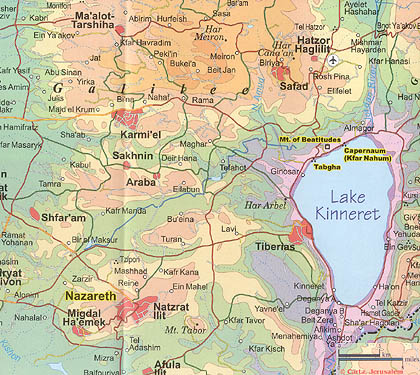
The Gospel of Luke, more than any other Gospel, is a travel narrative. It is Jesus’ travel log to Jerusalem in order to dangerously usher in the Kingdom of God. The Gospel is organized by Luke to have a geographic order in it.

So Luke records that Jesus started his adult ministry in Galilee (in the north) from Luke 4:14-9:50. In 9:51, the Gospel records that Jesus resolutely set his face like flint on Jerusalem. Resolutely. Like flint. Why? Because he has to go to Jerusalem to die. He must die. He must suffer. And he knows it. And he knows that he will die on a cross.

So in Luke 13:33, Jesus sends a message to King Herod in Jerusalem:
"Go tell that fox ... I must keep going today and tomorrow and the next day—for
surely no prophet can die outside Jerusalem."

So in Chapters 9:51-19:41, he takes a road south up to Jerusalem.In Luke 19, he enters Jerusalem on a donkey. And he stays there for the rest of the Gospel. And, of course, the whole thing spirals like a whirlwind within days to his execution.

Why do I say all that?

Because the risen Messiah Jesus requires something of you in all this travel. He requires you to daily take up your cross and then to follow him. (Luke 9:23)

That’s not a New Year’s Resolution. It’s a New Year’s Revolution.

That’s what Jesus requires of you: To drop all your baggage that holds you back, and pick up the only thing you need:

A cross.

And then follow him.

So the obvious question is: How do I do follow him to the cross outside Jerusalem? Especially since I live nowhere near Jerusalem, and last I checked, the Romans don’t use crosses anymore.

All of Luke in some way or another helps us answer this question. How do I journey life near -- and one step behind -- my Lord Jesus?

And our text, Luke 2:40-52, helps to answer this question. It is the stunningly unique story of Jesus as a Boy. This text is a mini travel narrative in itself: from Galilee up to Jerusalem for the Passover. In some ways it foreshadows the rest of the Gospel.

So how do I follow this King Jesus?

Here is the structure of my sermon: The Boy Jesus takes us in this text to at least three places:

1. Jesus takes us from the Pious to the Personal.
2. Jesus takes us from mere Information to true Insight.
3. Jesus takes us from the Passover to the Passion.

To be continued...