Tuesday, February 20, 2007

Post #3: The Second Surprise ...

(First read the Introduction and the first surprise, and the TEXT: Luke 16)

The 2nd surprise is that the rich man gives his economist a window for that manager to take advantage of him. Some of you know exactly what I mean by this. Some of you are bosses. If you are about to sack someone and you think that that person is then going to do any damage to your corporation, what do you do? You tell them to be out within the hour, and make no phone calls, and leave the computer right where it is.

Look at V2 – He summons him…

"What is this that I hear about you? Give me an account of your management, because you cannot be my manager any longer."
In the words of the immortal Trump: "You’re fired."

And yet he gives him this window of time. This small amount of time to go away and then come back and give him an account of his management...

What was our rich man thinking he was going to do? Maybe he was hoping he’d fess up and beg for mercy and pay back four times that amount. We’re about to hear about a man like this in the story of Zacchaeus (Luke 19).
You know...I don't know. Maybe he thought that he was going to reform??
Our third surprise...
Tomorrow.

Monday, February 19, 2007

Post #2: The First Surprise ...

(First read the Introduction and the TEXT: Luke 16)

There are at least four surprises in the story.

The first is this: Because you know the gospel, you expect the crook to throw himself on his master’s mercy and find grace and forgiveness. Just like lots of stories in the gospels (and of Luke in particular). A classic example: the woman who wipes Jesus' feet with her tears. (Luke 7)

That’s what you expect. But instead the crook capitalizes on his master’s apparent stupidity. And then … he totally lucks out.

It’s like the synopsis of a Woody Allen film.

V1 –“Then Jesus said to the disciples, There was a rich man.”

He is very very rich. The sums he’s lends out are ENORMOUS.

The rich man has a ‘manager’ – literally in the Greek – he is the ‘economist’ – a ‘Supervisor’ of the household -- in charge of all his master’s affairs. He’s the ‘Super’ (For our US readers). But he’s been doing deals with the money and squandering the property that doesn’t belong to him. (V1).

He is Jeff Skilling from Enron.
He is Marc Rich with the US taxpayer.

So how do I know that we EXPECT the story to go the normal route of forgiveness and grace?

A similar phrase “squandered his property” V1 has been used in the parable just before this one. In that case to the Prodigal son, who squanders his father’s property, discovers he is in a bad way, and he says “What will I do?” And then he throws himself on the mercy of his father; who then embraces the prodigal.

But you’ve just read the story – It simply doesn’t end that way.

So the second surprise is...

Tomorrow...

Post #1: Unexpected and Surprising


Thanks for your help last week. Below (and this rest of the week) is what I came up with. There will be about 7 posts. That'll make them more bite-sized. Comments, questions, complaints are welcome.

First, read the TEXT: Luke 16

Introduction:

We don’t expect pastors and preachers to say unexpected things from their pulpits. And if they do, it’s often simply bombastic, or over the top, or heretical. (And they sometimes get a little media attention for it for their troubles.) But when someone says something unexpected and surprising that actually has some wit and clarity. Some real wisdom that has the potential to shape life: That’s what I call a golden moment.

Well...I have no such moment for you this morning.

But Jesus does (Luke 16).

This parable is a strange parable. Its very odd and hard to grasp. Rudolph Bultmann said that it was insoluble. I'd say: 'Hard to pin down'. But I think that it has a terrific punch line.

There are at least four surprises in the story.

Tomorrow, surprise Number 1...

TBC.

Sunday, February 18, 2007

Jim Packer in the 80s, Rob Bell in the 00s?

Tell me the truth.

First, to understand this post, you must read THIS - It is Ben Witherington's post on Rob Bell's speaking tour. (You'll need a few minutes). Read the comments too.

Amongst lots of thoughts on reading that Blog, I have this one:

When we were at University, everyone I know read people like Stott, Packer, Carson and Wright and others like them to learn and explore difficult things from the Bible. If we needed to know what the Ancient Jewish traditions were, it was scholars we turned to -- people whose academic 'runs were on the board'. We 'listened' to them debate. And if we didn't read them, we talked and listed to those who had read and digested these guys. The scholars may not have been particularly creative writers or outstanding speakers. But they spoke the truth with some level of authority. They wrote the proverbial book on these subjects. And they showed all their 'working out' in endless footnotes and bibliographies.

Now, more and more people are turning to Rob Bell, Mark Driscoll and Brian McLaren and others to educate us about theology and 1st century Jewish history and how they relate to the interpretation of Scripture and culture.

I know that popular speakers have always made clear what the academics have said. We all went to Katoomba Conventions and loved it. We all had good pastors teaching us the Scriptures faithfully within community and in creative ways that we could understand.

But now its global.

At least three things have changed:
  • We are getting to be impatient readers -- They've all read Blue Like Jazz and Velvet Elvis, but try handing a student today John Stott's The Cross of Christ. Too much theology for some.
  • A distrust of authority -- Academics get it wrong all the time. If they can get it wrong, then it doesn't matter whether a person is proven to know their subject. Especially if they 'connect' with young people and 'connect' with culture.
  • The invention of iPod and iTunes, togther with the 2 minutes it takes to download any old junk.

Am I right? And have we taken a turn for the worse? And is there any hope?

I'm not sure. All I know is that Ben Witherington III sat waiting in a packed house ready to watch Rob Bell speak about the history of Judaism and its impact on Christianity.

Methinks it should have been the other way around.

Saturday, February 17, 2007

Friday Night Video: Nathan Tasker

My good friend Nathan Tasker is the answer to many prayers. His songs and his music testify to the Truth in every excellent way. On my Ipod, half of my 'most played songs' are from the album "Must Be More". These songs lift my soul, and make me live beyond my soul.

Nathan and Cassie have just moved to the States, which is Australia's loss and America's gain. I highly recommend poking around his website: www.nathantasker.com. And for you to watch this new presentation:


Tuesday, February 13, 2007

Help me...

I'm preparing for a sermon on Sunday. And I'm looking for help. My hat is in my hand, and any nickels and dimes might be of assistance. Maybe this could be a collaborative effort?

Click on Luke 16:1-13 for my text: The so-called 'Parable of the Dishonest Manager'.

I get this bit:
V8: The master commended the dishonest manager for his shrewdness. For the sons of this world are more shrewd in dealing with their own generation than the sons of light.
But this bit is not clear:
V9: And I tell you, make friends for yourselves by means of unrighteous wealth, so that when it fails they may receive you into the eternal dwellings.

Every time I've read these verses, I feel like I'm trying to push a square peg through round hole. So can you answer maybe any one of the following questions for me?

  • What do these verses mean?
  • Is Jesus being serious??
  • How do these verses challenge the 'people of the light'?
  • Is there something obvious that I am missing? Maybe something in its historical context? Or in the original languages?
  • Have you preached on these verses? Or have access to someone who has?
  • What are the best commentaries on this? And the wildest applications?
  • Do you have any online resources? Solid MP3 sermons on this text that I can listen to on the subway?

Go on -- have a go.

"Feed the faith of the saints in Manhattan." says Justin, opening his cap for anything to feed on.

Friday, February 09, 2007

1961-2007 -- 45 years in NYC

Graeme Goldsworthy was a lecturer at Moore College in Sydney when I was a student there from 1995-1997. I made contact with him yesterday to show him This Post from an appreciative American Pastor in California.

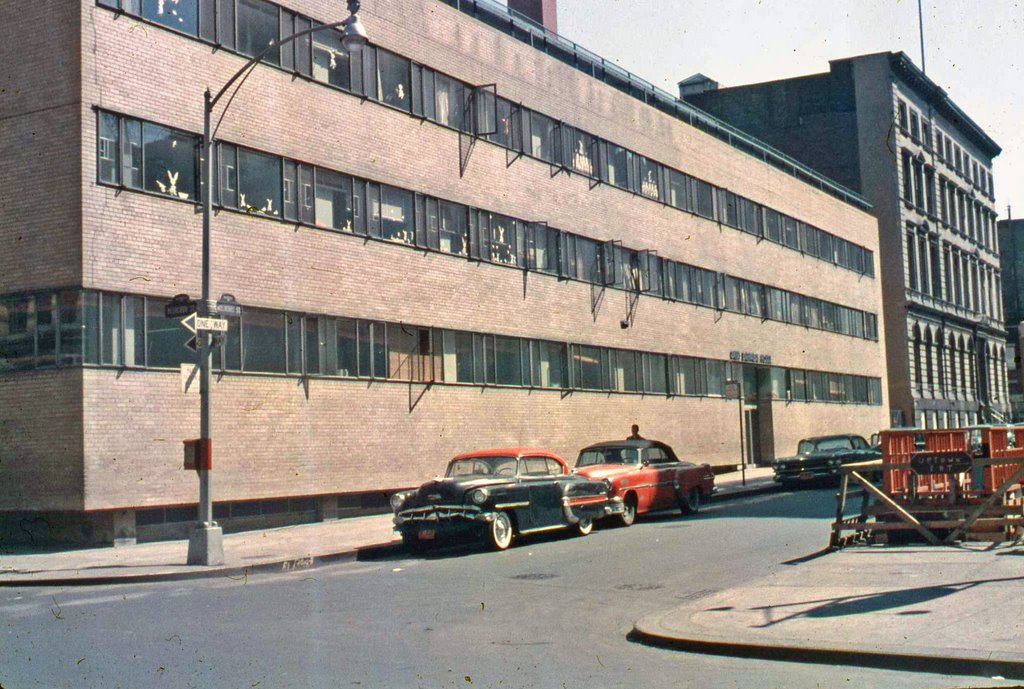
Graeme kindly replied to my email. He let me know that he too spent some time in NYC. He was here in 1960-61 working as a minister out of a hostel kind of near where I currently live. Corner Bleeker and Mulberry St.

He sent me this Picture of the building he worked in 1960-61. And he ask me to see how it had changed in 45 years.

I went to NYU today, and walked past up Bleeker St. Here is the same site in 2007:

Click on the pics if you want to make them larger.

I notice seven things:

1. How cool is the difference between the two cars in front? Chevy to VW.
2. There must be a fire hydrant behind the two cars, and it has not been moved in 45 years. Hence the gap between the two cars and the next one.
3. The owners of the building have doubled the size of the building since 1961.
4. Notice the windows – the building has been turned, I think, into apartments.
5. The one way streets have not changed, nor the base of the lamp post.
6. Someone has planted trees since 1961.
7. Here is what I found most fascinating: That’s a subway stop on the right, on both pics. It is the entrance in 2007 to the Uptown 6 Local Train. It was, in 1961, called Lexington Ave IRT (which you can see if you look closely in Graeme's Pic) – but still the same train.

I love this kind of stuff.

Wednesday, February 07, 2007

Tech Savvy

OK. So I'm standing in the kitchen, and Laurel's phone starts to ring. We all have Caller ID. I look to see who is calling.

The person calling: 'JUSTIN'.

This can't be right. My cell phone is sitting in its drawer. Maybe its been stolen.

I come out of the kitchen. And there is The Boy. Phone unlocked. Laurel's number found. Green button pressed. And Boy looking up cheekily at me.

How does this happen?

He's 2.

Thursday, February 01, 2007

Link from Tubeo


(Click on Pic)

Craig Tubman -- your REFLECTION on this picture is spot on. (Save the year? You marked the pic as 2000). I think that it was a mere few weeks before wife and I were married in Atlanta.

Glorious times. Glorious God.

HERE is a good verse for you, CT, and for all those who served on that Houseparty.

Tuesday, January 30, 2007

"We are all Going to Hell": Raw insight.

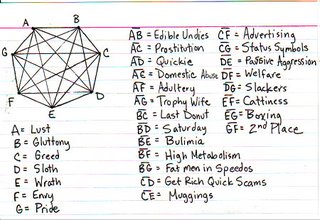
I wish that this hadn't made me laugh (Click on Pic for the artist). If I hadn't laughed, I might have cried. I wish I knew which response to give. Either way, this chart is full of raw insight (and I say that like there is another kind). Not least of which is its title: "We are all going to Hell".

I am reminded of this verse from the Apostle Paul:
The saying is trustworthy and deserving of full acceptance, that Christ Jesus came into the world to save sinners, of whom I am the foremost.
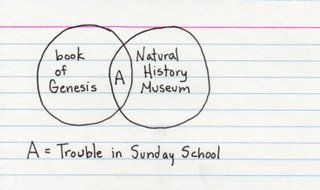
I highly recommend subscribe to ‘www.indexed.blogspot.com’. My other favourite:

Some New Pics


As the Scriptures say...

As a father shows compassion to his children,
so the LORD shows compassion to those who fear him.
For he knows our frame;

he remembers that we are dust.

Thursday, January 25, 2007

A Cynic's Guide to the TV version of the State of the Union.

I can’t turn ‘The State of the Union’ off once it’s on. Never have been able to. It’s mesmeric.

But I’ve been thinking about how the speech must have changed since the introduction of TV cameras into the chamber. All those senators and congressmen who have to communicate their approval and disapproval in a quick grab of TV: I feel sorry for them.

So I’ve decided this year to give you ‘A Cynic's Guide to the TV version of the State of the Union.’

This post is not a Cynic’s Guide to the actual speech. I think that it would be a difficult speech to give, and so I do not want to speak about it with hubris. Besides, you can find the Bush cynics on a million Blogs. This post is not a Cynic’s Guide to politics, nor is this a Cynic’s Guide to government per se. I believe that God institutes government, and they deserve respect and/or challenge, but not cynicism. Besides, I’ve railed against cynicism for years. Cynicism holds the promise of intelligent fun, but only delivers cheap bitterness.

However, I am happy to be cynical about TV.

Below is a Cynic's Guiide to the TV version of the State of the Union:

1. For the viewing public, arrange for the White-Woman-Hillary-Clinton to sit directly behind rival Democrat African-American-Barak-Obama. And then have Ted Kennedy sit directly next to Obama. It’s more entertaining than the Super-bowl.

2. Having TV in the chambers means that the only expression of support or disgust by the senators and congressmen is clapping. Clapping? Clapping, for the record, is a limited form of communication.

3. However, there are ways to communicate on TV while clapping: For example – hold a piece of paper in your hands as you slowly clap. You can look cool and indifferent to your supporters, but not totally anti-Bush for the swing voters.

4. Another example of communicating from the floor: when there is a standing ovation, stand 10 seconds later than the Republicans. Then we know where you really stand on the issue.

5. If the camera faces you, and you don’t like President Bush: Look down. Just look down. Or keep your finger to your forehead, and look down, like Ted Kennedy.

6. If you’re Nancy Pelosi, smile as much as you can. Look Bi-Partisan. And choose your protests carefully. It’s your debut as a clapper and a non-clapper. This is your chance to tell us what you really think.

7. The only winners in an era of TV are the Justices of the Supreme Court. They court no votes, and are clearly told to look like they have no body, parts or passions (to quote the 39 Articles).

8. If you the President (whether you are Rep or Dem), mention your most controversial issues as your penultimate topic (not too early, and definitely not last). And then finish with any of the following words, speaking with palpable hope: Darfur, poverty, disease, HIV, education, affordable, hero, or Freedom.

Have I missed anything?

Thursday, January 11, 2007

Snow Update

I wrote that last post and then went to straight a meeting in the East Village.
The flurry of snow came and went in minutes. Minutes.
As I walked, the sun came out and the flurry of snow disappeared.

Reminded me of Hosea 6:4. Says God:
"What can I do with you, Ephraim? What can I do with you, Judah? Your love is like the morning mist, like the early dew that disappears.

Hmm. An insightful verse into the human condition.

Snow

I looked out my window one minute -- its fine.
A minute later, I look out -- snow.
Its been the longest times between snow in NYC since 1878.
Cool.

Friday, January 05, 2007

5-0


Australia won the Ashes over England with a 5-0 whitewash. The last time that an Ashes series was a whitewash was Warwick Armstrong's 1920-21 post-World War 1 test team. England was decimated by Australia then, as today. Even Bradman’s Invincibles (Post World War 2: 1946-7) drew one of their tests against England.

Of course, cricket history is something Michael Jensen can tell us about...

MPJ?

Point 3: Jesus takes us from the Passover to the Passion.

Comments and corrections welcome.
Read the text HERE
Read the introduction: New Year's Revolution.
Jesus takes us to three places:
Point 1: Jesus takes us from the Pious to the Personal.
Point 2: Jesus takes us from mere Information to true Insight.

Point 3. Jesus takes us from Passover to the Passion.

Here is something interesting: The Gospel of Luke is Jesus’ travel log to Jerusalem. Jesus only gets to Jerusalem in his adult ministry in Ch 19 (The so-called Triumphant entry).

In Luke’s account, there are only three recorded times that Jesus goes to Jerusalem before he begins his adult ministry.

As a baby, his parents offer a sacrifice, as was the pious duty of a Jewish parent.
As a boy, our text here, at Passover time.
As a man, just before he begins his ministry, the devil takes him to Jerusalem to tempt him NOT to take the path of the cross. The devil basically tempts Jesus saying that God wants Jesus to have his Best Life Now, and to avoid the cross, and conflict, and suffering, and rejection.

Each time, there is this foreshowing of the sacrifice and the passion of the Christ.

Here in our text, they are there in the Temple at Passover.

Passover was the time when Israel remembered that a lamb must be sacrificed; an offering must be given for sins to be covered. For judgment to be avoided. A lamb must be sacrificed before the people can be set free. That’s what Joseph would have been instructing Jesus in.

And Jesus is there, in the temple, in Jerusalem, at Passover. And he says: V49

“Did you not know that I must be in my Father’s house?”

The original language is not ambiguous about the “must” there in that sentence. It carries with it a strong – ‘have to’ – ‘it is a necessity that’. The very kind of ‘must’ he uses later to say he must die...

What is slightly more ambiguous is how to translate “in my father’s house”.

Literally, it is: “Did you not know that I must be ‘in the things of my Father’” Or maybe: “Did you not know that I must ‘concern myself with my Father’s matters’?” The older translations said: “my Father’s work”. It seems deliberately ambiguous.

And “My Father’s matters” is that God seeks and saves the lost. (Luke 19:10). “My Father’s business” is that Jesus must die in Jerusalem for sin.

Jesus takes us from Passover to the Passion.

I find it interesting that Joseph, the father, lost his son for three days. And he astonished over this.

I find it faith compelling that God the Father lost his Son for three days. And the Father was in agony over this.

Jesus cried on the Cross: “My God, My God, why have you forsaken me?” or maybe: “Why have you lost me?”

Jesus takes us from Passover to the Passion.

So -- to sum up. To be a father is, in part, to give your child your eyes. Your outlook. Your view of how things are: the nature of things. Your view of the future: The shape of things to come.

Joseph probably wanted for Jesus to be a pious Jew, honorable and capable. He wanted him to grow strong and maybe join the carpentry business. He wanted to put his hands to work on wood.

But Jesus knew -- at least by 12 -- knew that he was going to give Joseph his eyes.

To be The Father God is, in part, to give his Son his eyes. His outlook. His view of how things are: the nature of things. His view of the future: The shape of things to come. And that involved Jesus having a personal relationship with God. Where his hands went to work on wood, yes. But only together with the metal of a Roman executer’s nails.

And this mean giving Joseph and Mary -- and you the one who joins Jesus in his travel -- He gives you the eyes of a personal God, whom you can seek, and you will find in Jesus.

THE END…

Thursday, January 04, 2007

Point 2: Jesus takes us from mere Information to true Insight.

Read the text HERE
Read the introduction HERE and first point HERE.
Comments and corrections welcome.
Jesus takes us to three places:

2. Jesus takes us from mere Information to true Insight

V 46-47:
"After three days they found him in the temple, sitting among the teachers, listening to them and asking them questions. And all who heard him were amazed at his understanding and his answers."
How great it would be if we simply followed Jesus at this point?

Now, I recognize that Jesus is special. This is the Messiah -- the one -- according to Isaiah 11:2 who has “The Spirit of wisdom and of understanding, the Spirit of counsel and of power.”

However, there is something very simple going on here. He is with the teachers. And he has listening to them, weighing up what they say, engaging with them humbly, asking good follow-up questions, straining and yearning for truth and righteousness.

And he’s presumably been doing it for 3 days.

Why don’t we do this more often? Gain a little more traction with the Bible? Why don’t we listen closely to those who can help us. To ask questions in Bible Study? And to contribute to answers when we can. Wouldn’t it be great to read my Bible and to mark questions I that I have? Read more good books. Not just popular ones. And then seek answers, and not rest until I have them.

A little more thirst is a good way to start to follow Jesus.

But its not just information we seek. But insight.

Jesus is a theological genius, but not just a theological genius. We do not need to fill our hearts with simply more information, but with wisdom that comes from the Lord. And that’s the “genius” that God gave Jesus.

The text says: V47:
"They were amazed at his understanding."
‘Understanding’ is a good translation. But the original word carries a bit more weight than that. Perhaps the word 'insight' would be better. The word we translate ‘understanding’ is the Greek word, which forms the basis of our English word ‘synergy’ or ‘to synthesize’: 'To bring it together'.

Jesus can see how it all fits together.

Dietrich Bonhoeffer:
"To understand reality is not the same as to know about outward events. It is to perceive the essential nature of things. The best-informed man is not necessarily the wisest. Indeed there is a danger that precisely in the multiplicity of his knowledge he will lose sight of what is essential."
Jesus is asking questions -- Maybe he is making links for the teachers that they had never known.

Was he asking questions about the coming Messiah? Was he showing them Isaiah 53 and Daniel 7? And showing how they could fit together in one Messiah? Was he asking questions about Torah? And how the law could be fulfilled in the coming of the Messiah?

If we follow Jesus, we don’t just study scripture. But we find in them Jesus, of whom the Scriptures testify. We find a person. That’s insight.

In what particular way might we fit all this together? Lastly, tomorrow:

3. Jesus takes us from Passover to the Passion

TO BE CONTINUED...

Wednesday, January 03, 2007

Point 1: Jesus takes us from the Pious to the Personal.


Read the text HERE

Read my introduction HERE

Comments and corrections welcome.
Jesus takes us to three places:

1. Jesus takes us from the Pious to the Personal.

To be pious to be devoted to a religious practice and to religious ideals. It’s to be devout. But Jesus will take you to a personal relationship with his Father.

There of course can be good pious and bad pious. What Mary and Joseph did every year was good pious. V41 --

Now every year, Jesus parents went to Jerusalem for the festival of the Passover.

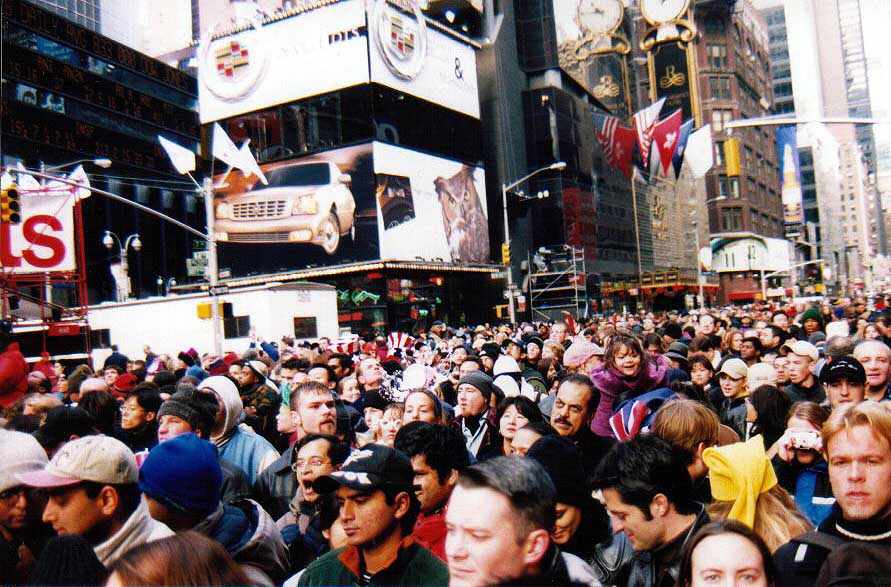
It’s worth saying that they are doing what the Hebrew Religion required of them. God required Jewish people to come to Jerusalem for the Passover. And so the city of Jerusalem swelled something like 8 times its normal size. A little bit like Times Square tonight. Mary and Joseph are devout Jews. And so they go up every year.

V42 -- When Jesus was 12 years old (so specific), his parents went up to the festival.

Why be so specific? Its one year from 13, the year when a young Jewish boy becomes a man, and takes on the responsibilities of manhood. What happens the year before? Read the Jewish Mishnah describing an ancient Jewish Custom:

“They should not cause children to fast on the Day of Atonement, but they should train them one or two years before they are of age, that they may become versed in the commandments.

One or two years before age 13, a father was meant to teach his son what it meant to be a man. Both spiritually: The father taught the 11 or 12 year old to know the commandments. And he taught him about the Passover by taking him around Jerusalem, answering his questions, teaching him to be a pious Jew. But also economically: The son would have been taught the father’s business. And the son was required to seek out and learn all he could from his father. “Dad, Abba, teach me this. Why do we do that?”.

This particular Passover would have been a very special time for father and son.

However, in a dramatic turn of events, the Boy Jesus calmly stays behind in Jerusalem (V43) while the whole caravan -- the village sets out back to Nazareth.

We have to climb into their travelling world: My commentaries tell me that the women set out first with the children. (Because they were encumbered). And the men of the village set out last. But Jesus is on the threshold of manhood, right? So maybe Mary thinks that Joseph is doing his duty as a Father. And Joseph thinks that Jesus has gone with the kiddoes and the women. In any case, at the rendezvous place on the first night, no little Yeshua. Not anywhere. Not with a relative and no friend has seen him since they were in Jerusalem (V44).

So they go back to there (V45). And the third day after leaving Jerusalem they found him in the temple (V46). Calm as a cucumber. Safe as houses.

But they let him have it. They are astonished. Incredulous.

And she responds with a healthy dose of fear and relief. V48:

“Child, why have you treated us like this?” “Look, your father and I have been searching for you in great anxiety.”

Maybe she’s saying something like this:

“Jesus, you are a year from manhood. This is the year that you are supposed to be learning from your father. This year of all years, you are supposed to be learning responsibility. And yet you stayed here in Jerusalem...You are still a child.”

In light of all this, Jesus response is even more astounding. V49 --

He said to them: “Why were you searching for me? (There was no need to search). Did you not know that I must be in my Father’s house?”

But they didn’t get it. (V50) You see what is potentially happening here:

Mary:

“This year especially, you are supposed to be learning from your father.”

Jesus:

“I am” (!!)

Jesus was a great son, and obedient to the 5th commandment. We know that from V51.

But Jesus is claiming here something new. Something unheard of. Something scandalous. Something liberating. Something that we in our modern times miss because of familiarity.

He is saying:

“Joseph, Dad, Abba, I love you. I’ll obey you and honor you. (V51) But my relationship with my Heavenly Father transcends even my relationship with you.”

Here is the thing: Jesus is the first person to use so regularly such personal language for his relationship with God. The Old Testament rarely used such intimate terms. And other ancient religions certainly did not. You never used such personal address. It was way too intimate. Way too audacious.

Jesus is opening up a way to God that wasn’t just pious, but personal.

The language of sonship then is then spread everywhere in the New Testament. The adult Jesus starts to talk about those who trust him as sons of God. John the Apostle says:

“How great the father’s love lavished on us that we can be called the children of God.”

Paul says that:

“When the time had fully come, God sent his Son, born of a woman, born under law, to redeem those under law, and give them full rights as sons, and therefore heirs according to promise... Because you are sons, God sent the Spirit of his Son into our hearts, the Spirit who calls out, "Abba, Father."

And it’s Jesus who takes us there. Jesus takes us from being simply religious to being in a relationship with our heavenly father.

Do you understand this?

Maybe not. If not, then you are in good company. Mary and Joseph didn’t either. But they didn’t reject it either. Mary, we are told, “treasured this in her heart”. That is -- she withheld judgement until it made sense to her.

This leads perfectly to our next point...Tomorrow:

2. Jesus takes us from information to Insight...

To be continued...

Tuesday, January 02, 2007

A New Year’s Revolution (Sermon Introduction)

Happy New Years folks...

The text for yesterday’s sermon was Luke 2:40-52. Please read the text first. Any comments welcome:

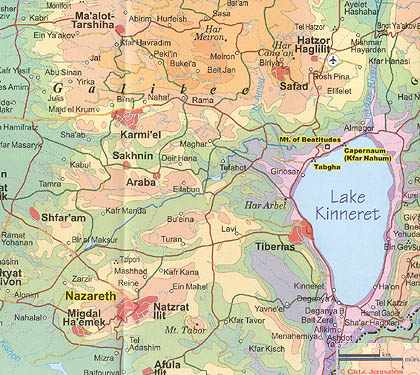
The Gospel of Luke, more than any other Gospel, is a travel narrative. It is Jesus’ travel log to Jerusalem in order to dangerously usher in the Kingdom of God. The Gospel is organized by Luke to have a geographic order in it.

So Luke records that Jesus started his adult ministry in Galilee (in the north) from Luke 4:14-9:50. In 9:51, the Gospel records that Jesus resolutely set his face like flint on Jerusalem. Resolutely. Like flint. Why? Because he has to go to Jerusalem to die. He must die. He must suffer. And he knows it. And he knows that he will die on a cross.

So in Luke 13:33, Jesus sends a message to King Herod in Jerusalem:
"Go tell that fox ... I must keep going today and tomorrow and the next day—for
surely no prophet can die outside Jerusalem."

So in Chapters 9:51-19:41, he takes a road south up to Jerusalem.In Luke 19, he enters Jerusalem on a donkey. And he stays there for the rest of the Gospel. And, of course, the whole thing spirals like a whirlwind within days to his execution.

Why do I say all that?

Because the risen Messiah Jesus requires something of you in all this travel. He requires you to daily take up your cross and then to follow him. (Luke 9:23)

That’s not a New Year’s Resolution. It’s a New Year’s Revolution.

That’s what Jesus requires of you: To drop all your baggage that holds you back, and pick up the only thing you need:

A cross.

And then follow him.

So the obvious question is: How do I do follow him to the cross outside Jerusalem? Especially since I live nowhere near Jerusalem, and last I checked, the Romans don’t use crosses anymore.

All of Luke in some way or another helps us answer this question. How do I journey life near -- and one step behind -- my Lord Jesus?

And our text, Luke 2:40-52, helps to answer this question. It is the stunningly unique story of Jesus as a Boy. This text is a mini travel narrative in itself: from Galilee up to Jerusalem for the Passover. In some ways it foreshadows the rest of the Gospel.

So how do I follow this King Jesus?

Here is the structure of my sermon: The Boy Jesus takes us in this text to at least three places:

1. Jesus takes us from the Pious to the Personal.
2. Jesus takes us from mere Information to true Insight.
3. Jesus takes us from the Passover to the Passion.

To be continued...

Monday, January 01, 2007

Trying to post a new pic

Trying to post a new pic for my profile.